
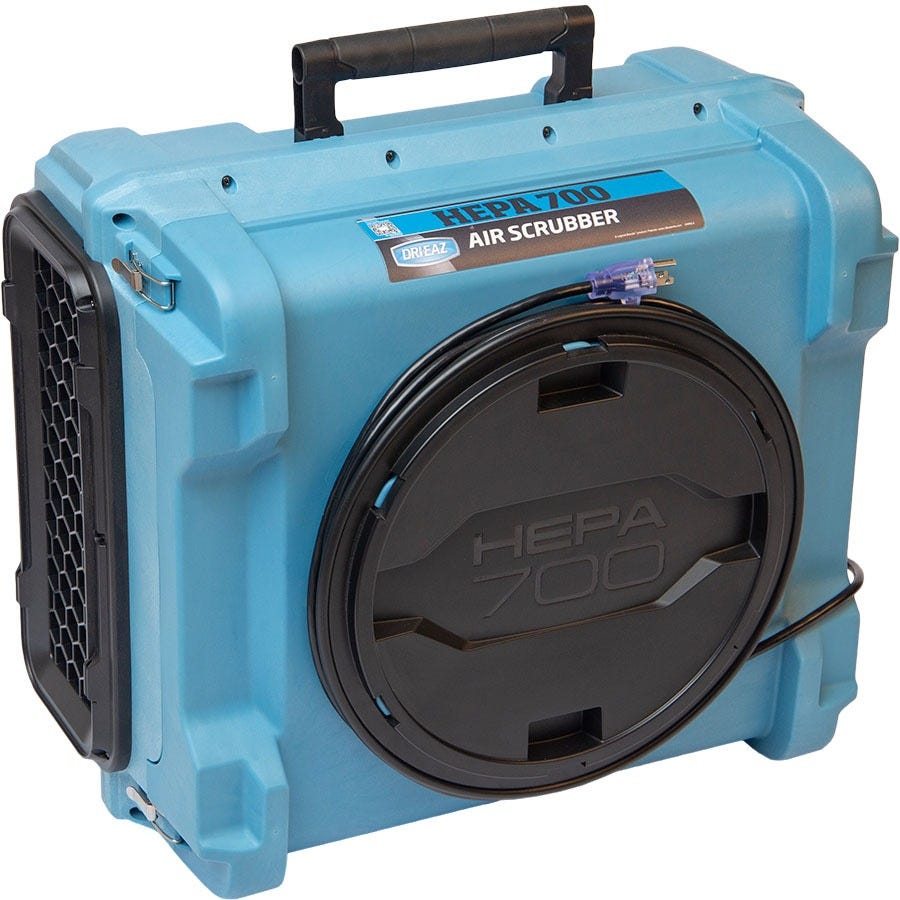
The Dri-Eaz HEPA 700 is a compact, stackable air scrubber, and its most useful feature for a multi-room containment job is one crews frequently under-use: an onboard GFCI outlet that lets units daisy-chain off a single circuit instead of hunting for a separate outlet per scrubber. Set up correctly, that feature turns one 15-amp circuit into power for an entire floor's worth of negative-air filtration. Set up wrong, it trips a breaker mid-job.
Basic setup, before the daisy chain
- Fully unwrap the power cord — a coiled cord under load is a heat risk on any equipment, not just this one.
- Place the unit with the handle up, and confirm neither the inlet nor the outlet is obstructed by containment poly, debris, or a wall.
- Plug into a standard 115V, GFCI-protected outlet — the unit's own onboard GFCI protects downstream daisy-chained units, but the first unit in the chain still needs a protected source.
- Download the Dri-Eaz Command Center app (iOS/Android) and pair it via the built-in Command Hub for remote monitoring, speed control, and filter-status alerts across the job.
The daisy-chain math that actually matters
The number that trips people up is that the 8-unit daisy-chain limit only applies at the lowest speed setting. Run the same chain at the highest speed and the ceiling drops to four units on that same 15-amp circuit — the higher CFM draw pulls more current per unit, so the circuit fills up twice as fast. A crew that plans a job around the 8-unit number and then runs everything on high speed for faster drying time will trip the breaker mid-shift, usually at the worst possible moment. Plan the chain size around the speed setting the job actually needs, not the headline daisy-chain number on the spec sheet.
Sizing the room, not just the circuit
Daisy-chain math solves the electrical side; room sizing solves the actual filtration question. The HEPA 700's variable airflow — 275 to 700 CFM depending on speed — means a single unit can be tuned to the space instead of always running wide open, which matters for noise-sensitive occupied spaces as much as for power budgeting. A negative-pressure containment calculation (room volume × target air changes per hour ÷ 60) determines how many units and at what speed a given containment actually needs; the daisy-chain limit is a constraint on that plan, not a substitute for doing the ACH math first.
Most equipment failures on a negative-air job aren't the scrubber underperforming — they're a circuit that was daisy-chained past its real capacity because the speed setting wasn't factored in, or a room that was under-scrubbed because the ACH math never got done. Both are a five-minute planning step before the first unit gets plugged in, and both are cheaper to get right at setup than to diagnose mid-job.