
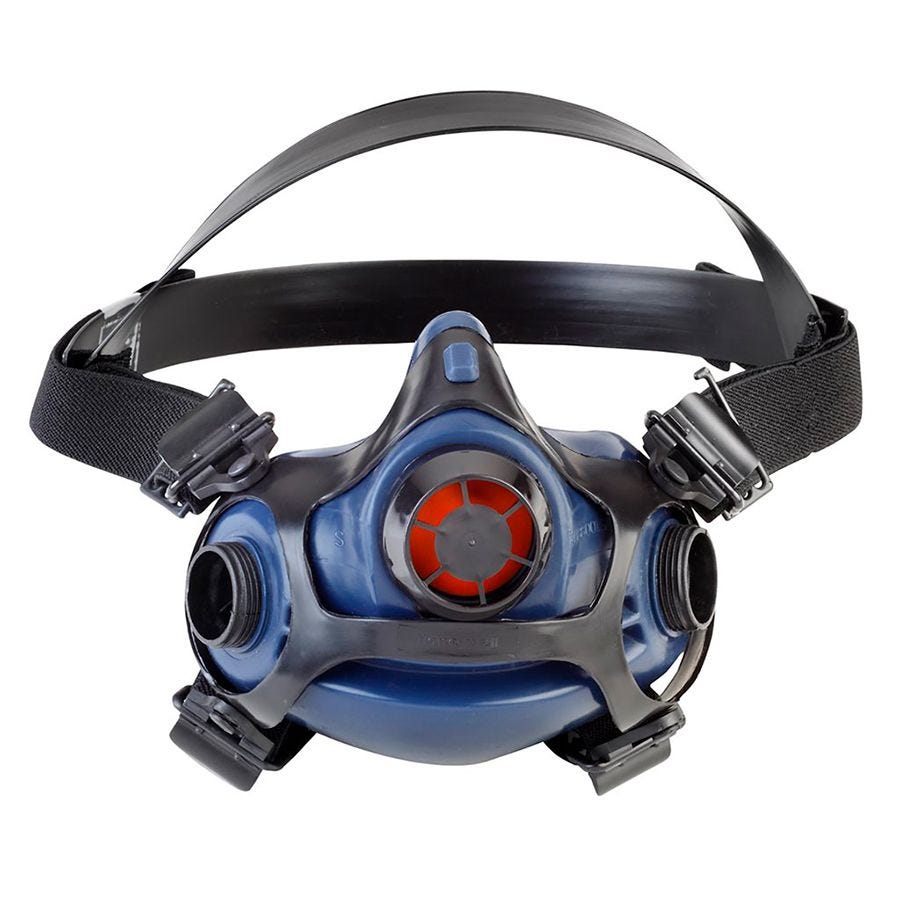
The Honeywell North RU8800 half mask gets specced onto a lot of INLINE job kits because it's built specifically for hard-to-fit faces — a wraparound profile, facepiece pleats that guide the mask into position, and a triple-flange design with three distinct sealing surfaces. That engineering only pays off if the respirator is donned correctly and matched to the right cartridge for the actual contaminant on site. Both steps are governed by OSHA's respiratory protection standard, not just good practice — and both are where crews most often cut a corner without realizing it.
Sizing and donning — the part a fit test can't fix later
The RU8800 ships in two sizes, and Honeywell's own guidance is direct about who fits where: the small size suits extra-small or petite faces, while the medium/large is built for broader or longer faces. Sizing has to be right before a fit test even starts — a fit test verifies the seal of the respirator someone is already wearing, it doesn't correct a fundamentally wrong size. Donning follows the same logic as any half-mask: seat the nose bridge first, pull the headstraps evenly over the crown and back of the head, and adjust tension until the mask sits snug without pinching — over-tightening distorts the silicone seal instead of improving it.
- Inspect the facepiece, valves, and cartridges for cracks or damage before every use — a compromised seal defeats the design regardless of fit.
- Position the mask over nose and mouth, pull the lower strap behind the neck, then the upper strap over the crown of the head.
- Adjust both straps evenly for a snug, even seal — no gaps, no pinch points, no single strap doing more work than the other.
- Perform a user seal check every time it's donned: cover the cartridges or inhalation ports and inhale gently (negative check — mask should collapse slightly toward the face), then cover the exhalation valve and exhale gently (positive check — no air should escape around the seal).
- If either check fails, readjust and recheck before entering the work area. If it still fails, the size or model may be wrong for that face.
Cartridge selection is a separate decision from fit
A well-fitted respirator with the wrong cartridge is still an exposure risk — cartridge selection depends on the actual airborne contaminant, not on what happens to be on the shelf. Particulate work (dust, fibers, mold spores) calls for an N95/N100-class filter; organic vapors, acid gases, and other chemical exposures each require a cartridge rated for that specific hazard class, and combination cartridges exist for jobs with more than one contaminant present. The facepiece, cartridge brand, and cartridge series all have to be compatible — Honeywell publishes a cartridge and filter reference chart specifically because mismatches are a common, avoidable error.
Confirm the correct cartridge class for the job before dispatch — the wrong cartridge is invisible to a seal check.
"Fit testing is required in the exact make, model, and size actually worn, at assignment and at least annually — plus a user seal check at every single donning."
— Summarized from OSHA 29 CFR 1910.134
None of the above substitutes for a formal, OSHA-compliant respiratory protection program — qualitative or quantitative fit testing administered by a trained provider, a medical evaluation before first use, and a written program under 1910.134(c) are legal requirements, not optional best practice. What this guide covers is the part that happens on site every single day: whether the mask someone already fit-tested in is actually sealed and cartridge-matched before they walk into the work area. That's the step most exposure incidents trace back to — not the absence of a program, but a rushed donning on an ordinary Tuesday.