
Disposable coveralls and suits by the case
INLINE Distributing sells disposable coveralls by the case to abatement, restoration and construction crews: DuPont Tyvek 400, DuPont ProShield 50 and 60 microporous, Protega microporous, SMS and P2 suits, and a Liberty Safety polypropylene spun suit, nearly all with attached hood and boots. For chemical splash work it carries DuPont Tychem 2000 and 10000 and Lakeland ChemMax 1. Order online, on the Quick Order page, through the quote form or at 1-800-795-0933.
Coverall case calculatorRequest a quoteOrder desk 1-800-795-0933Find a branch
At a glance
- DuPont lists Tyvek 400 at 1.2 oz/sq yd, ProShield 50 at 1.5, ProShield 60 at 1.8 and Tychem 2000 at 2.5.
- Protega microporous, SMS and P2, the polypropylene spun suit, ProShield 50 and Lakeland ChemMax 1 come 25 per case.
- Size runs: Tyvek 400 M to 4XL, ProShield 60 and Protega microporous L to 4XL, Tychem 2000 XL to 4XL.
- Chest ranges differ by line: a 45 in chest is XL in Tyvek 400 but 2XL in ProShield 60 and Tychem 2000.
- Tyvek 400, ProShield 50 and 60, Tychem 2000 and ChemMax 1 list serged seams; the Tychem 10000 encapsulated suit has double taped seams.
- Paste part numbers on the Quick Order page, send a list through the quote form, or call the order desk at 1-800-795-0933.
Every disposable coverall and suit INLINE sells, side by side
Each row is one suit line with its maker, fabric, hood and boot style, size range and case pack, taken from INLINE's product records, with a photo and a link to the product page where every size carries its own part number. Compare fabric first, then confirm the line runs in the sizes your crew wears.
| Coverall or suit | Material | Hood and boots | Sizes | Pack |
|---|---|---|---|---|
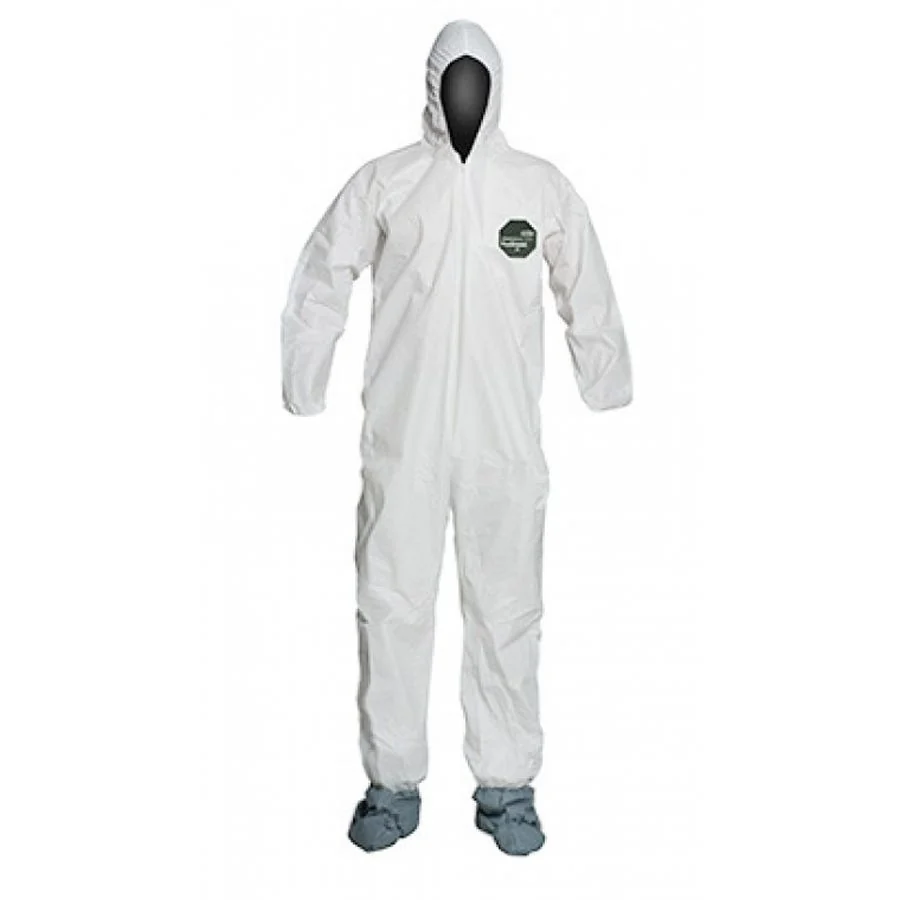
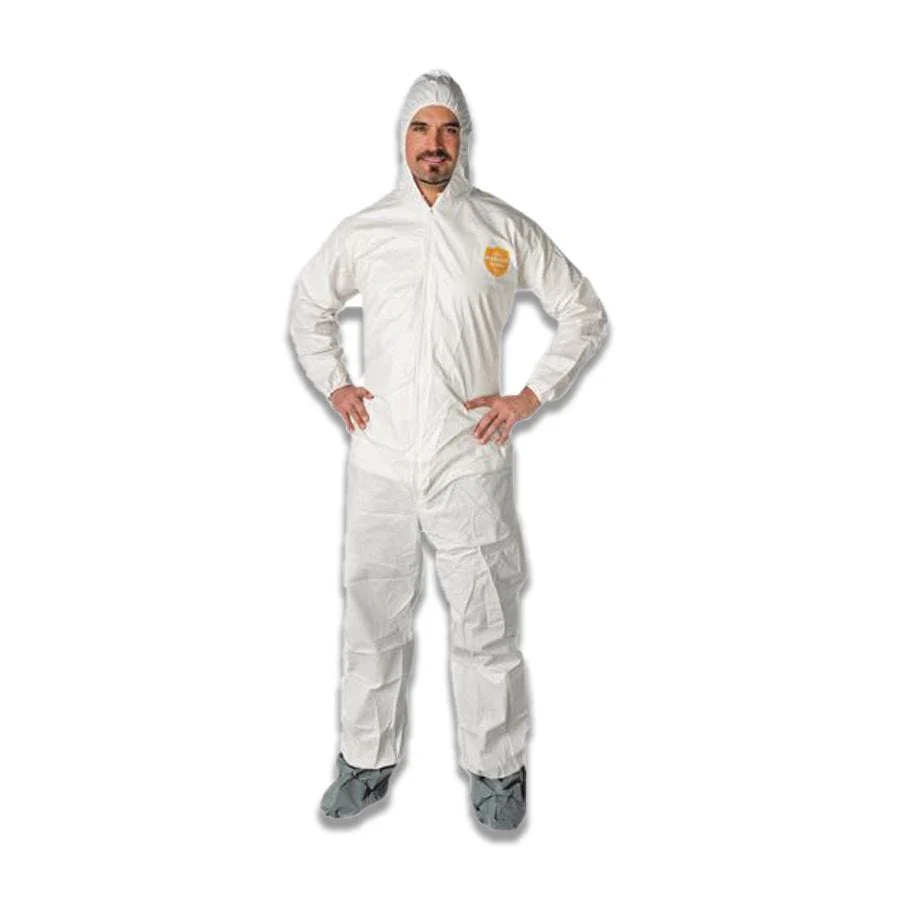
| DuPontDuPont ProShield 50 Disposable Coverall with Hood and Attached Skid-Resistant Boots, White | MaterialProShield 50 | Hood and bootsHood and skid-resistant boots | Sizes2XL, 3XL | Pack25 per case, per the DuPont style number |
| DuPontDuPont ProShield 60 Disposable Coverall with Attached Hood and Skid-Resistant Boots, White | MaterialProShield 60 | Hood and bootsHood and skid-resistant boots | SizesL, XL, 2XL, 3XL, 4XL | Pack25 per case, per the DuPont style number |
| DuPontDupont Tychem 10000 TK555TYL | MaterialTychem 10000 | Hood and bootsNot listed | Sizes2XL, 3XL, 4XL | PackSold each |
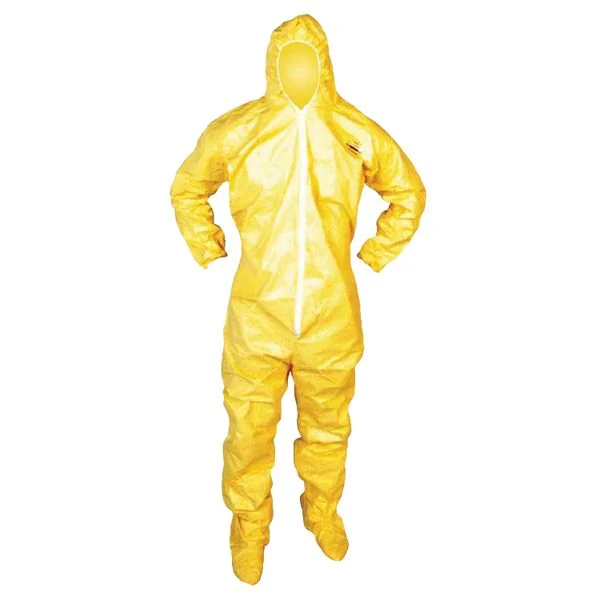
| DuPontDuPont Tychem 2000 Coverall with Attached Standard Fit Hood and Socks, Yellow | MaterialTychem 2000 | Hood and bootsHood and socks | SizesXL, 2XL, 3XL, 4XL | Pack12 per case, per the DuPont style number |
| DuPontDuPont Tyvek 400 Disposable Coverall with Respirator Fit Hood and Attached Skid-Resistant Boots, White | MaterialTyvek 400 | Hood and bootsRespirator fit hood, skid-resistant boots | SizesM, L, XL, 2XL, 3XL, 4XL | Pack25 per case, per the DuPont style number |
| INLINEPROtega Microporous Disposable Coverall with Hood and Attached Boots | MaterialMicroporous | Hood and bootsHood and boots | SizesL, XL, 2XL, 3XL, 4XL | PackNot listed |
| LakelandLakeland ChemMax 1 Serged Seam Coverall With Hood and Boots | MaterialChemMax 1 | Hood and bootsHood and boots | Sizes2XL, 3XL | Pack25 per case |
| Liberty SafetyPolypropylene Spun Suit with Hood and Boots | MaterialSpun polypropylene | Hood and bootsHood and boots | SizesXL, 2XL, 3XL | Pack25 per case |
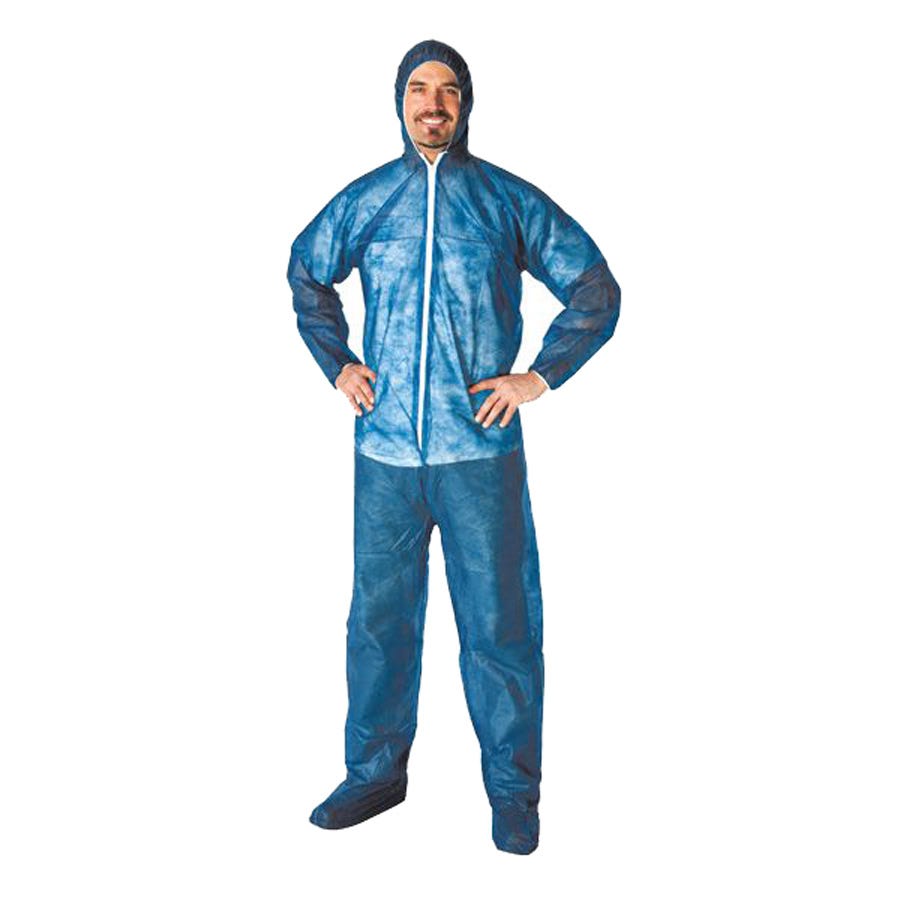
| ProtegaBlue Polyprop Spun Suit with Hood and Boot (Protega SMS) | MaterialSMS polypropylene | Hood and bootsHood and boots | Sizes2XL, 3XL | Pack25 per case |
| ProtegaProtega P2 Heavyweight Polypropylene Suit | MaterialHeavyweight polypropylene | Hood and bootsNot listed | SizesXL, 2XL, 3XL | Pack25 per case |
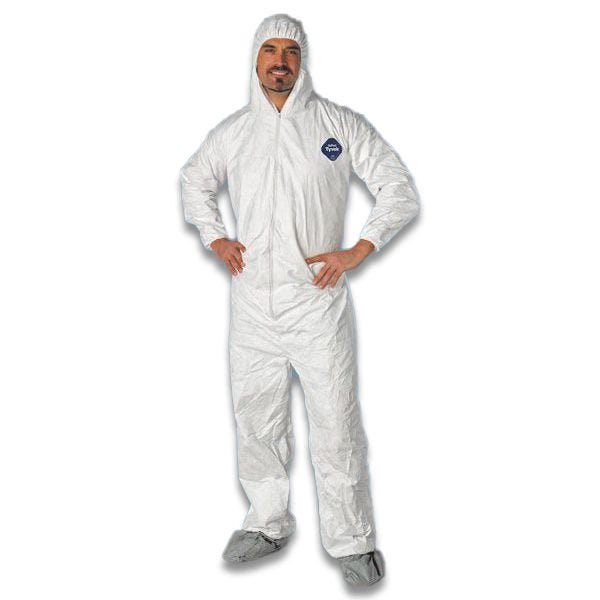
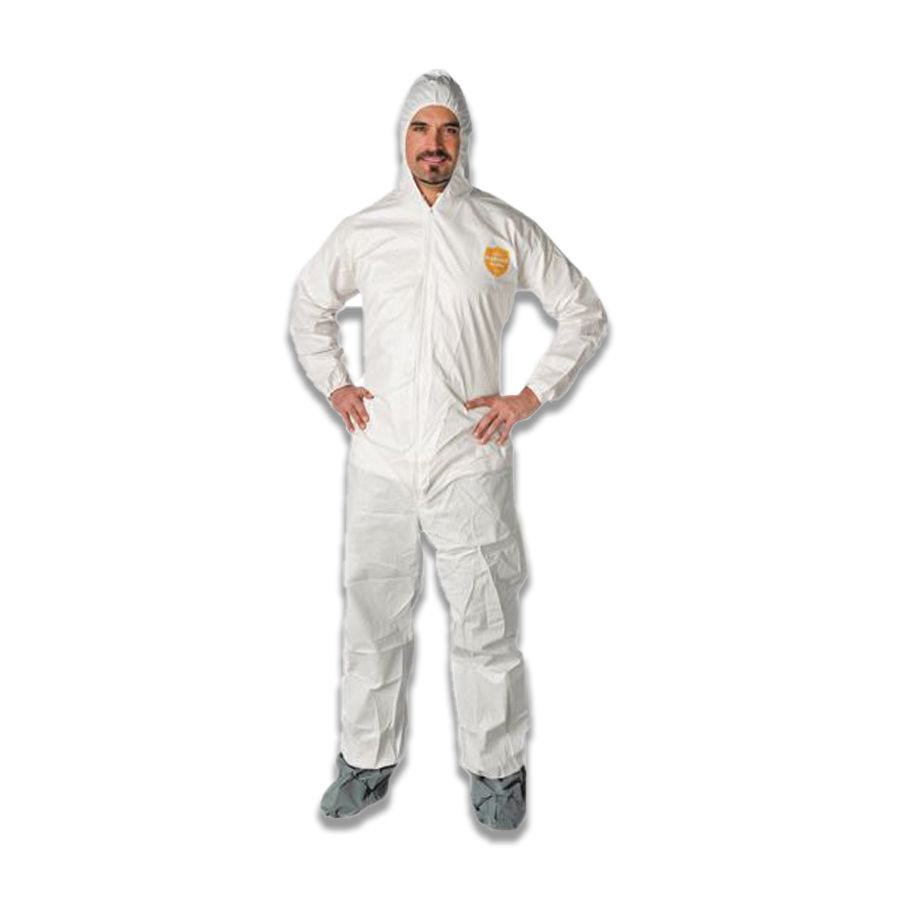
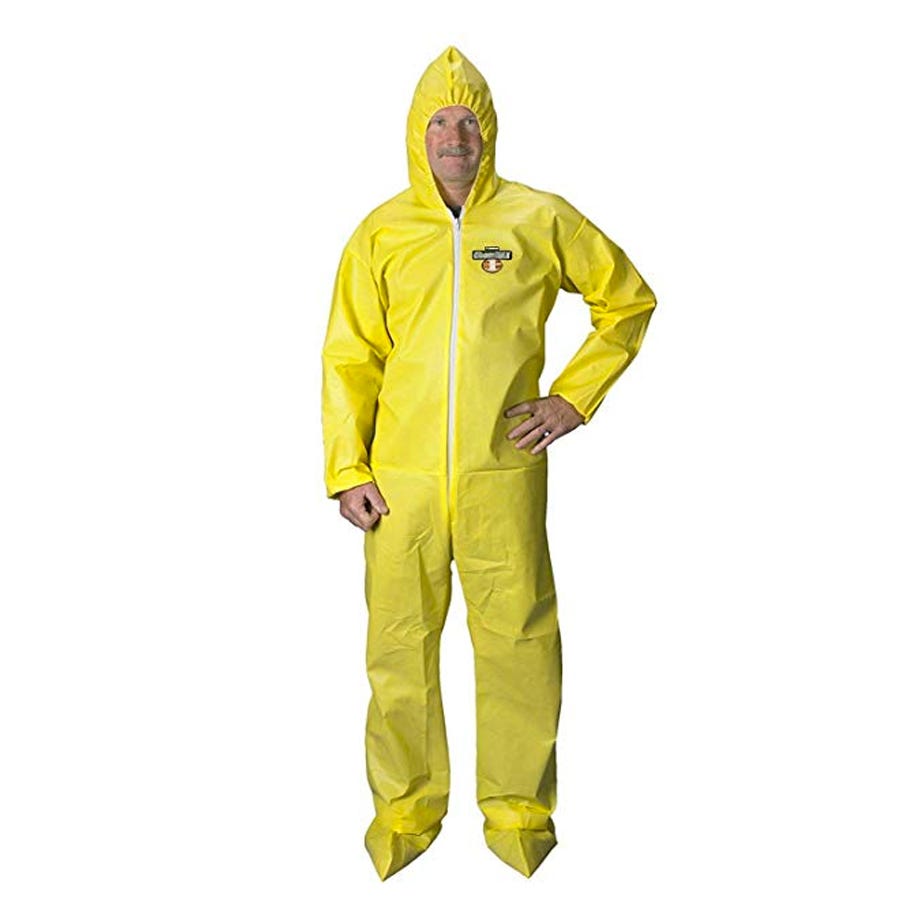
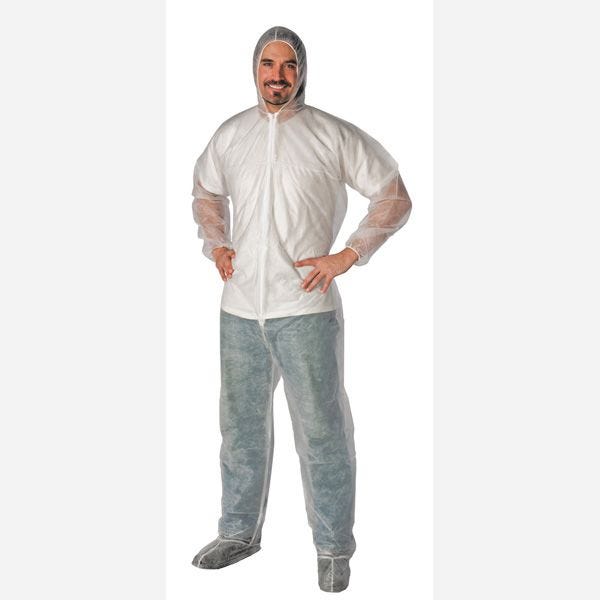
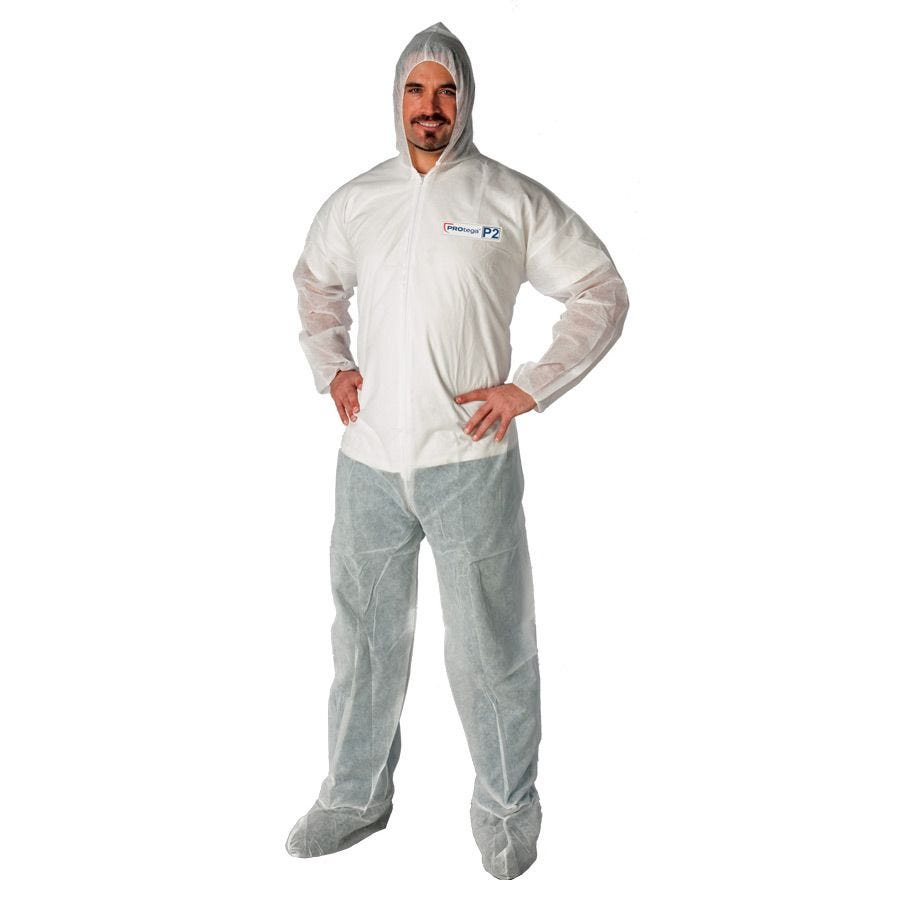
Cells come from each product listing. Sizes are the ones listed for that suit, and each size is its own part number. The product page has the full description.
Coverall fabrics compared: polypropylene, SMS, microporous, Tyvek
Fabric decides how much fine dust gets through and how hot the suit runs by midafternoon. Spunbond polypropylene is one open nonwoven web: it breathes best and is the loosest barrier of the group. SMS sandwiches a meltblown polypropylene layer between two spunbond layers, which tightens the web without adding a film. Microporous film laminate bonds a thin film full of tiny pores to a polypropylene backing, so dust and light splash meet a film face while some water vapor still escapes. Tyvek is flash-spun high-density polyethylene, a single sheet with no film or laminate to scuff off.
Fabric weight compares suits within one family, not across fabrics. ProShield 50 at 1.5 oz/sq yd and ProShield 60 at 1.8 are both microporous film laminate, and DuPont lists tear resistance on the heavier 60. Tyvek 400 is the lightest at 1.2 oz/sq yd, yet DuPont lists it for dry particulates, aerosols and pressurized spray, and says its barrier holds up after wear and abrasion better than microporous film fabrics.
| Fabric | INLINE lines | Weight on record | Heat on a long shift |
|---|---|---|---|
| FabricSpunbond polypropylene | INLINE linesPolypropylene spun suit, Protega P2 heavyweight | Weight on recordNot listed; P2 sold as heavyweight | Heat on a long shiftCoolest; air passes through |
| FabricSMS polypropylene | INLINE linesProtega SMS, blue | Weight on recordNot listed | Heat on a long shiftCool |
| FabricMicroporous film laminate | INLINE linesDuPont ProShield 50 and 60, Protega microporous | Weight on record1.5 and 1.8 oz/sq yd (ProShield) | Heat on a long shiftWarm; vapor escapes, air mostly does not |
| FabricFlash-spun polyethylene | INLINE linesDuPont Tyvek 400 | Weight on record1.2 oz/sq yd | Heat on a long shiftWarm |
| FabricChemical barrier fabric | INLINE linesTychem 2000, Lakeland ChemMax 1, Tychem 10000 | Weight on record2.5 oz/sq yd (Tychem 2000) | Heat on a long shiftLeast breathable |
Coveralls with hood and boots, hood and socks, or encapsulated
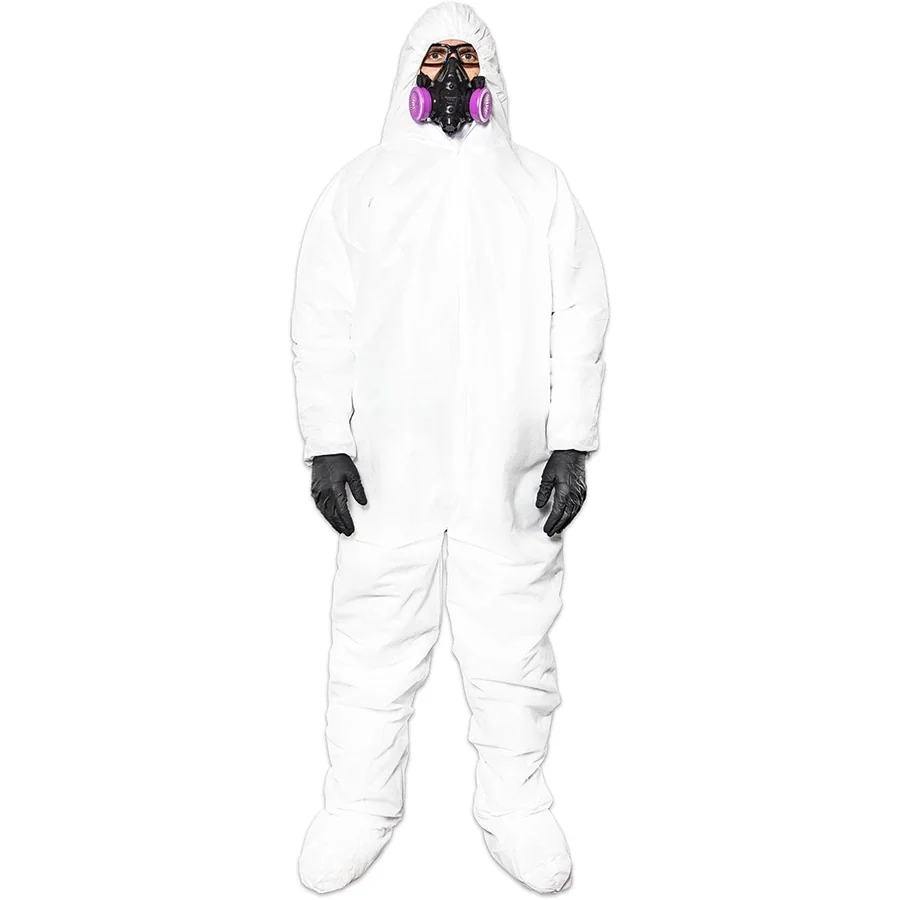
Nearly every disposable suit INLINE sells is the full-cover style with an attached hood and attached boots: Tyvek 400, ProShield 50 and 60, Protega microporous, SMS and P2, the polypropylene spun suit and ChemMax 1. Attached boots close the gap where a separate shoe cover slides down and the ankle elastic rides up. The ProShield 50 record gives boot length as 14-3/4 in at 2XL and 16-3/4 in at 3XL.
Tychem 2000 has an attached hood and socks made of garment fabric instead of boots. The sock goes inside a chemical boot and the suit leg goes over the boot top, so liquid runs down the outside. The Tychem 10000 encapsulated suit has attached socks with outer boot flaps. Over regular footwear, the Johnson Wilshire yellow latex haz-mat booties are 12 in tall with a sanded, grooved grit sole, sold by the pair: XL for shoe sizes 11 to 12, 2XL for 13 to 14 and 3XL for 16 and up.
- Tyvek 400: respirator-fit hood with an elastic face opening, cut to cover neck and chin and fit around a mask; the zipper runs to the chin; Tyvek FC boots carry a skid-resistant coating.
- ProShield 50 and 60: attached hood, skid-resistant boots and a pin-locking zipper slider that holds when the puller pins are pushed into the teeth; ProShield 60 lists an elastic face opening.
- Protega microporous: integrated hood, extra-long front zipper with a stopper at the top, non-skid boot soles.
- Protega P2 and Protega SMS: attached hood and boots, set-in sleeves, elastic wrists; P2 adds an elastic waist.
Serged, bound and taped seams on disposable coveralls
A serged seam is overlocked: DuPont describes interlocking threads sewn around the raw fabric edges. Needle holes run the length of the seam, and the serged suits on this page are listed for particles and light splash. A bound seam folds a strip of fabric over the serged edge to cover the stitching. A taped or sealed seam heat-seals a strip over the stitch line to cover the needle holes.
On INLINE's shelf, Tyvek 400, ProShield 50 and 60, Tychem 2000 and Lakeland ChemMax 1 all list serged seams; the Protega and polypropylene spun records do not state a seam type. Tychem 10000 is the taped suit: each sewn seam is covered inside and outside with heat-sealed tape. Lakeland makes ChemMax 1 with serged, bound and sealed seams, and the version on the shelf is serged. When your project specification names bound or taped seams, write that on a quote request.
Disposable coverall size chart for XL to 4XL
Size letters do not line up across lines, even within DuPont. A worker with a 45 in chest is an XL in Tyvek 400, which runs 42-3/4 to 46-1/4 in, but a 2XL in ProShield 60 and Tychem 2000. Take the chest measurement over the sweatshirt or layers that go under the suit, and when a worker falls between sizes, go up one.
Inseam matters as much as chest for tall workers. ProShield 60 runs from 27 in at L to 28-3/4 in at 3XL and 4XL, while Tyvek 400 runs from 29 in at L to 32-1/2 in at 4XL and Tychem 2000 from 29 in at XL to 32 in at 4XL. A suit short in the body pulls at the crotch on every kneel and ladder climb, which is where serged suits split. Several case-pack lines come only in 2XL and 3XL: ProShield 50, Protega SMS and ChemMax 1.
| Size | Tyvek 400 | ProShield 60 | Tychem 2000 |
|---|---|---|---|
| SizeXL | Tyvek 40042-3/4 to 46-1/4 in | ProShield 6040-3/4 to 44-1/4 in | Tychem 200041-1/4 to 44-3/4 in |
| Size2XL | Tyvek 40045-1/4 to 48-3/4 in | ProShield 6044-1/4 to 47-3/4 in | Tychem 200044-1/4 to 47-3/4 in |
| Size3XL | Tyvek 40049-1/4 to 52-3/4 in | ProShield 6047-3/4 to 51-1/4 in | Tychem 200047-1/4 to 50-3/4 in |
| Size4XL | Tyvek 40052-3/4 to 56-1/4 in | ProShield 6051-1/4 to 54-3/4 in | Tychem 200050-3/4 to 54-1/4 in |
Best disposable coveralls for asbestos, mold, soot and painting
The table pairs each kind of job with the suits whose own records name that work. The suit for a given job still comes from your project specification or industrial hygienist. Fire and smoke cleanup is not named in any of INLINE's coverall records, so that row is trade practice: greasy soot wipes off a film or flash-spun face more cleanly than it comes off open polypropylene.
| Job | Suits whose records name it | Note |
|---|---|---|
| JobAsbestos abatement | Suits whose records name itTyvek 400, ProShield 60, ProShield 50 | NoteTyvek 400 also lists lead abatement |
| JobMold remediation | Suits whose records name itTyvek 400, Protega microporous | NoteProtega lists remediation |
| JobFire, smoke and soot cleanup | Suits whose records name itNone by name; Protega P2 lists general restoration | NoteFilm or Tyvek face for greasy soot |
| JobInsulation and attic work | Suits whose records name itPolypropylene spun suit | NoteCoolest fabric on the shelf |
| JobPainting and coatings | Suits whose records name itPolypropylene spun, Protega P2, Protega microporous, Tyvek 400 | NoteTyvek 400 lists spray painting |
| JobAutomotive refinishing | Suits whose records name itProShield 60 | NoteNamed in its applications |
| JobWastewater treatment | Suits whose records name itLakeland ChemMax 1 | NotePolyethylene film over polypropylene |
| JobIndustrial chemical light splash | Suits whose records name itTychem 2000 | NoteHood and socks; add chemical boots |
When to step up from a disposable coverall to a chemical suit
The dust suits on this page are listed for dry particles and light, non-hazardous splash. Once the job puts a named liquid chemical on the suit, selection moves from fabric type to permeation data for that exact chemical, which is in the maker's permeation guide and the chemical's SDS. Breakthrough time is measured chemical by chemical.
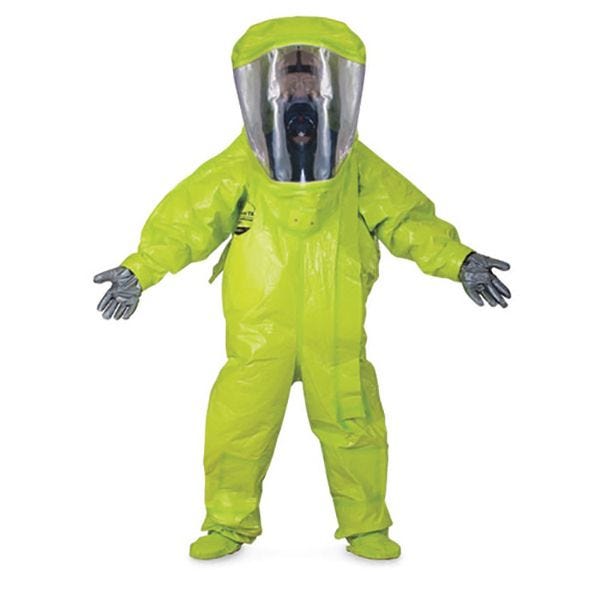
INLINE carries three steps. DuPont lists Tychem 2000 as 2.5 oz/sq yd fabric with at least 30 minutes against more than 40 chemical challenges, yellow, XL to 4XL. Lakeland ChemMax 1 is a polyethylene barrier film over a continuous filament polypropylene nonwoven, which Lakeland describes for most industrial acids and bases; it comes 25 per case in 2XL and 3XL. The Tychem 10000 encapsulated suit is lime yellow PVC/PTFE with double taped seams, a vapor-tight zipper, a wide three-layer face shield and an expanded back that fits a self-contained breathing apparatus, 2XL to 4XL. See the chemical suits shelf.
How many coveralls to order for a job
Use one formula: workers x suit changes per worker per day x work days, plus a spare allowance, divided by the case pack and rounded up to whole cases. The planning figures here are 2 changes per worker per day, one suit for the morning and a fresh one after the midday exit, and 15 percent spare for torn suits, wrong sizes and visitors such as an air monitoring technician. The calculator below uses the same math.
Worked example: 6 workers for 5 days at 2 changes is 6 x 2 x 5 = 60 suits. Add 15 percent and the job needs 69. At 25 per case that is 2.76 cases, so order 3 cases, or 75 suits. Then split the cases by size before you order, since each size is its own part number: for Protega microporous that is 440500 for L, 440058 for XL, 440044 for 2XL, 440045 for 3XL and 440059 for 4XL.
- Each extra trip out of the work area, such as a second break or an equipment run, adds one suit per worker per day.
- Hot attic or summer work: raise the figure to 3 changes when suits come off soaked.
- Demo on rough slab wears attached boot soles first; add spare rather than reusing a holed suit.
- Count supervisors and inspectors in the spare, not in the crew number.
Coverall case calculator
Enter the crew, the suit changes and the days, pick a coverall and split the crew by size. You get the cases for each size with its part number.
Your order
| Size | Part number | Suits | Cases |
|---|---|---|---|
| XL | 440016 | 69 | 3 |
How this is calculated: workers x changes a day x days, plus the spare percent, rounded up to whole suits, then divided by the case pack and rounded up for each size. XL: 6 x 2 x 5 = 60 suits, plus 15 percent = 69. 69 / 25 a case = 2.76, rounded up to 3 cases.
Your list
440016, 3
One line per part number with the number of cases.
Changes per day and the spare allowance are planning figures. The project specification and the site rules decide how often suits are changed.
How to put on, tape and take off a disposable suit
Have each worker squat and reach overhead in the suit before the shift; if the crotch pulls or the cuffs ride past the wrist, go up a size. The sequence below is common trade practice; your project specification sets the decon order on regulated work.
- Step into the legs and pull the attached boots over work shoes before the arms go in.
- Put the respirator on before the hood comes up, so the straps sit under the hood and the suit can come off while the mask stays on.
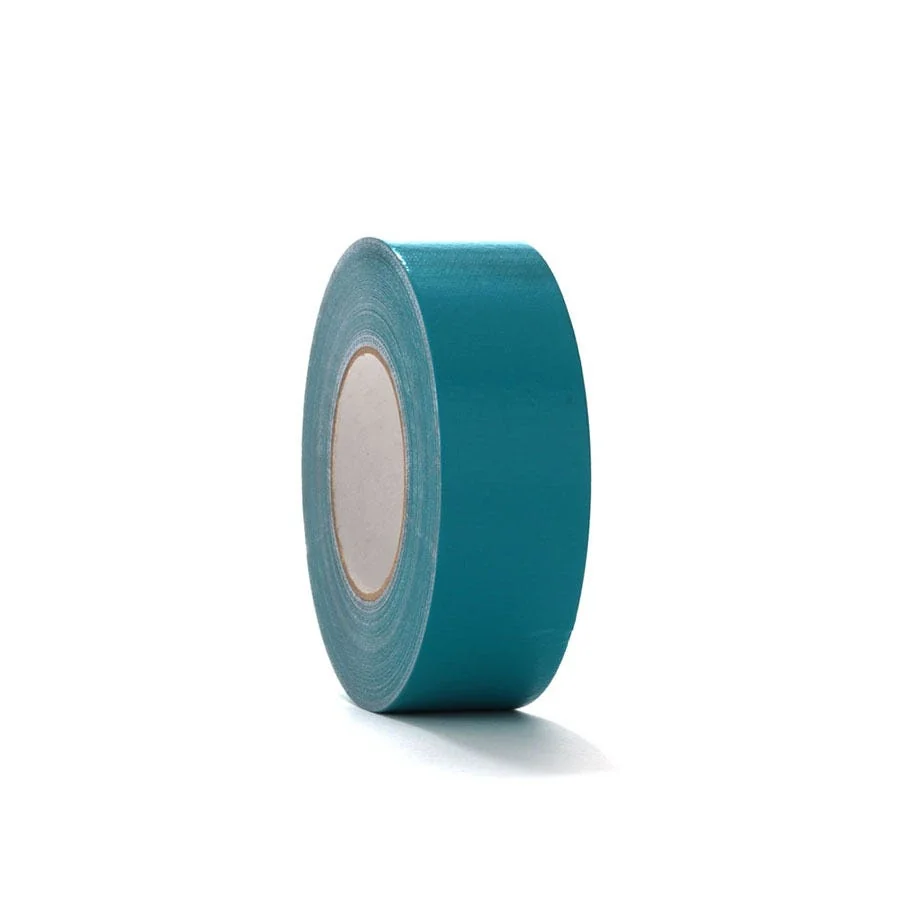
- Gloves go over the cuffs; wrap one turn of duct tape at each wrist and ankle and fold the end into a pull tab. INLINE 311 teal abatement duct tape is 11 mil.
- To take it off, pull the tape tabs, unzip, peel the hood back and roll the suit down inside out so the dirty face stays inside.
- Step out of the boots last and drop the suit straight into the waste bag the job calls for, such as printed asbestos bags on abatement work.
Products mentioned on this page
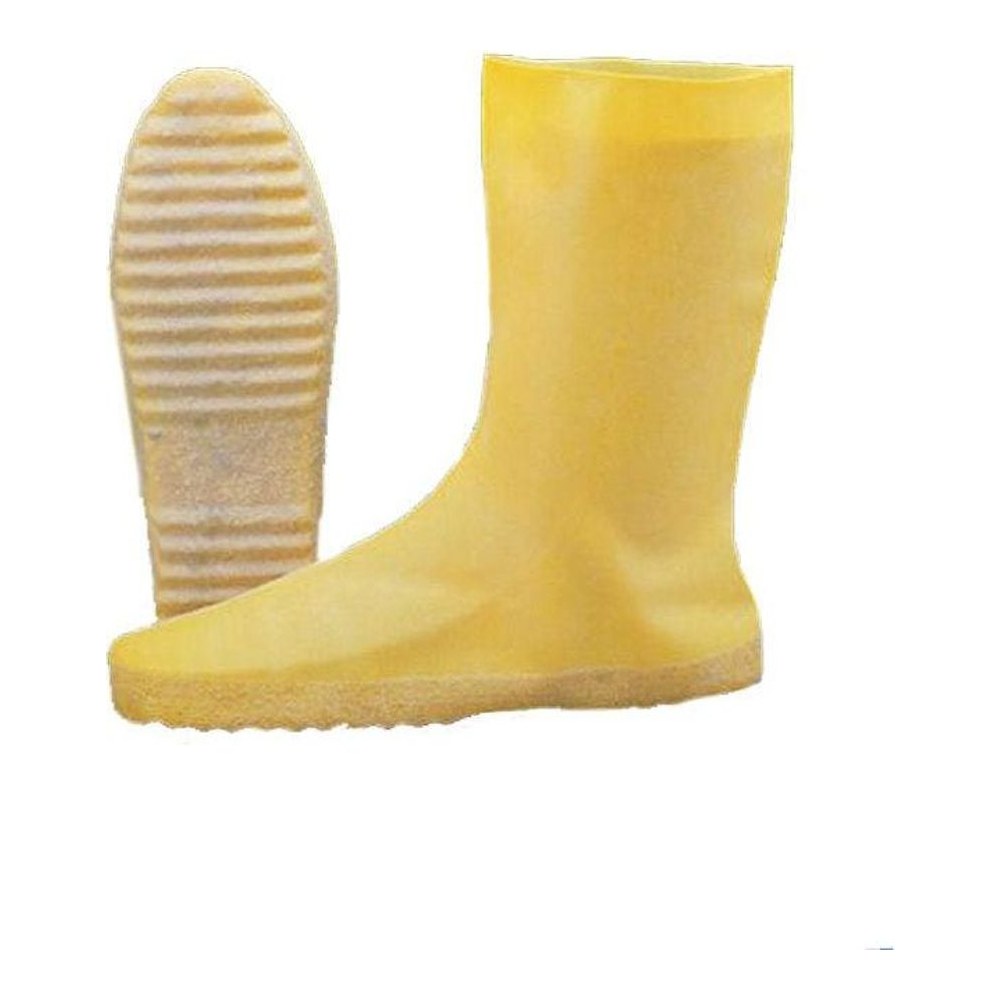 Johnson WilshireJohnson Wilshire Yellow Latex Haz-Mat Booties
Questions contractors ask
Is Tyvek 400 or a microporous coverall better for dusty work?
Both are listed for dry particles and light splash, so the choice usually comes down to fit, heat and wear. Tyvek 400 is a single flash-spun sheet with no film to scuff, and it has the respirator-fit hood. Microporous suits put a film face over polypropylene, and ProShield 60 adds weight that DuPont lists for tear resistance.
What is the difference between DuPont ProShield 50 and ProShield 60?
ProShield 60 is the heavier suit, 1.8 oz/sq yd against 1.5, built as microporous film laminated to spunbonded polypropylene and listed with tear resistance. Both have an attached hood, skid-resistant boots, serged seams and a pin-locking zipper slider. At INLINE, ProShield 60 runs L to 4XL and ProShield 50 comes in 2XL and 3XL, 25 per case.
What does SMS mean on a polypropylene coverall?
SMS stands for spunbond, meltblown, spunbond: three polypropylene layers with a fine meltblown web in the middle. It is tighter than plain spunbond polypropylene and still has no film, so it runs cooler than microporous suits. The Protega SMS suit is blue, with attached hood and boots, set-in sleeves and elastic wrists, 25 per case in 2XL and 3XL.
Do 3XL and 4XL disposable coveralls fit the same across brands?
No, each line follows its own chest chart. A 4XL fits a 52-3/4 to 56-1/4 in chest in Tyvek 400, 51-1/4 to 54-3/4 in in ProShield 60 and 50-3/4 to 54-1/4 in in Tychem 2000. Inseams differ more: 4XL is 32-1/2 in for Tyvek 400 and 28-3/4 in for ProShield 60, so tall workers often fit Tyvek better.
Which disposable coverall runs coolest for attic and insulation work?
The polypropylene spun suit runs coolest, because air moves through the open spunbond web, and its record names insulation and painting. It comes 25 per case in XL, 2XL and 3XL with hood and boots. The tradeoff is a looser web than SMS or film. See the heat stress shelf for crews on long summer shifts.
What is the difference between the Protega P2 and the polypropylene spun suit?
The Protega P2 is the heavyweight of the two spunbond polypropylene suits, and its record adds an elastic waist and lists tear resistance. Both have attached hood and boots and come 25 per case in XL, 2XL and 3XL. The P2 record names cleanup, painting and general restoration, while the spun suit record names painting and insulation.
What does a pin-locking zipper slider do on a ProShield coverall?
It keeps the zipper from creeping open. DuPont's record says the slider locks in place when the pins on the puller are pushed into the zipper teeth, so the front stays closed while the wearer bends, kneels and climbs. ProShield 50 and ProShield 60 both list it. To open the suit, lift the puller so the pins clear the teeth, then unzip.
Can I order one case of each size on the same order?
Yes. Each size has its own part number, so a mixed order is one line per size. Tyvek 400 runs 440014 for M through 440019 for 4XL, and ProShield 60 is 440089, 440046, 440047, 440048 and 440090 for L to 4XL. Paste the list on the Quick Order page, upload a spreadsheet, or send it through the quote form.